

Virtual Reality Training: How VR, AR and Mixed Reality Are Transforming Modern Learning
 Tejas Mishra
Training has traditionally depended on classrooms, presentations, manuals, videos, and practical demonstrations. These methods still have their place, but they share one major limitation: they explain an experience without always allowing the learner to actually experience it.
Imagine training an employee to respond to a factory emergency without stopping production. Imagine allowing a technician to practice repairing complex machinery before touching the real equipment. Imagine giving a construction professional the opportunity to understand a hazardous site before entering it.
This is where virtual reality training is creating a major shift.
Instead of simply reading about a procedure or watching an instructor demonstrate it, learners can enter a simulated environment and actively perform the task. They can make decisions, interact with objects, encounter unexpected situations, and learn from mistakes in a controlled digital environment.
At the same time, augmented reality and mixed reality are expanding the possibilities of immersive learning by bringing digital information into real-world environments.
The result is a new approach to training where learning is less about memorizing information and more about developing the confidence and skills to perform in real situations.
What Is Virtual Reality Training?
Virtual reality training solutions uses computer-generated environments to recreate real-world situations for learning and skill development. Using VR headsets and interactive controllers, a learner can enter a three-dimensional environment and interact with simulated objects, machines, people, and surroundings.
The important part is not simply the visual realism. Effective VR training is designed around what the learner needs to accomplish.
For example, an industrial employee may need to identify hazards before operating a machine. A VR scenario can recreate the workplace and allow the employee to identify unsafe conditions. A healthcare professional may need to respond to an emergency, while a construction worker may need to understand safety procedures on a simulated site.
In each case, the learner is placed inside the situation instead of being asked to imagine it.
That makes VR particularly valuable for training situations where physical practice is expensive, dangerous, difficult to arrange, or impossible to repeat frequently.
Why Companies Are Moving Toward Immersive Training
The workplace has become increasingly complex. Employees are expected to operate sophisticated equipment, follow strict safety procedures, and make decisions quickly.
Traditional training can communicate the rules, but there is often a gap between knowing something and being able to perform it.
A person might understand how a machine works after attending a classroom session, but that does not necessarily mean they will react correctly when something goes wrong.
Immersive training helps close that gap.
A learner can experience the situation, make a decision, and immediately understand the consequences. If they make a mistake, the scenario can be reset and repeated.
This creates something conventional training often struggles to provide: repeatable experience without real-world risk.
VR Training Solutions Are Becoming More Practical
The early perception of VR was largely associated with entertainment and gaming. That perception has changed significantly.
Today, VR training solutions can be designed around specific operational processes, workplace environments and business objectives.
For an industrial organization, a VR solution could recreate an entire production environment. Employees could practice machine operation, emergency procedures, maintenance activities, or workplace safety without interrupting actual operations.
For a construction company, the same technology could recreate a project environment and allow workers to practice identifying hazards or responding to site-specific situations.
The value comes from making the simulation relevant to the learner's actual work.
A generic virtual environment may look impressive, but a training simulation becomes much more valuable when it represents the equipment, procedures, and challenges employees encounter in their daily jobs.
VR Training vs AR Training vs Mixed Reality Training
VR, AR and MR are often discussed together, but they solve different problems. Understanding the difference is important when deciding which technology is appropriate for a particular training requirement.
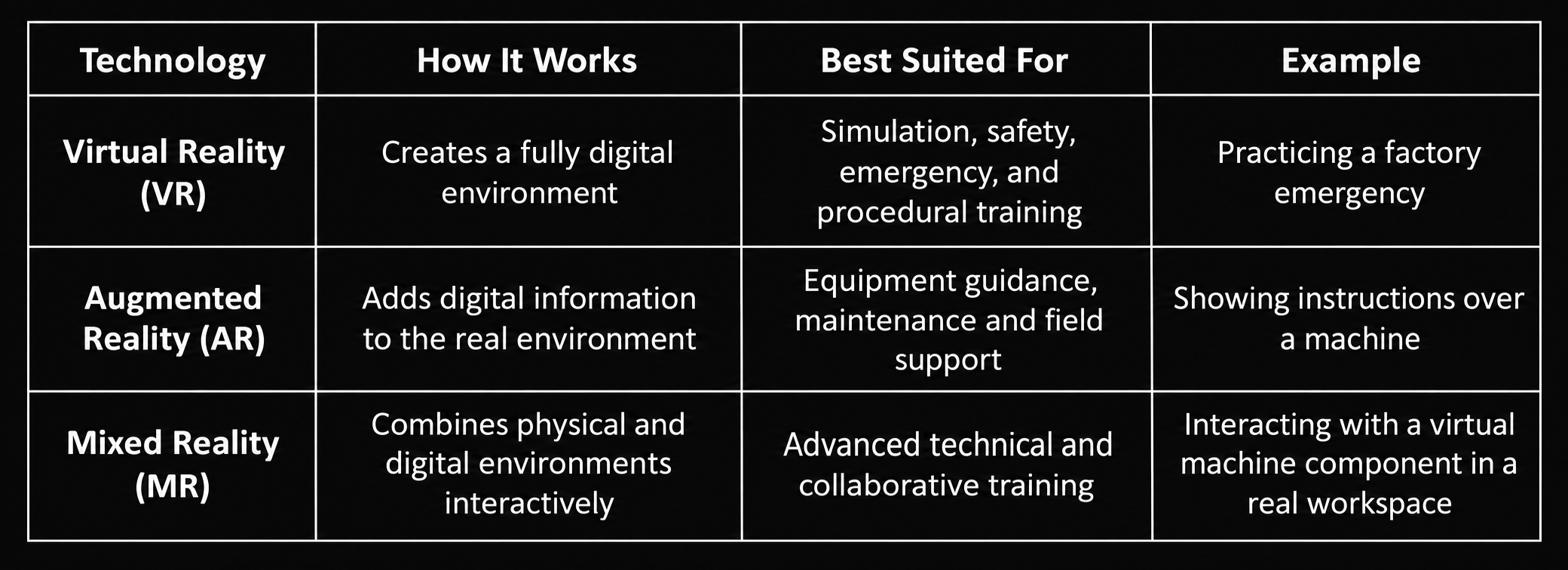
The choice should therefore begin with the training objective rather than the technology.
If the learner needs to completely enter a simulated environment, VR may be the best option. If the learner needs digital guidance while working with real equipment, AR may be more appropriate. When physical and virtual elements need to interact, mixed reality can provide a more advanced experience.
The Role of an Immersive Learning Platform
An immersive learning platform takes immersive training beyond individual VR experiences.
Instead of treating VR as a one-time demonstration, organizations can use a platform to manage multiple training experiences, users, assessments, and performance data.
This creates a more structured learning ecosystem.
A learner might first receive theoretical information through conventional digital learning. They could then enter a VR simulation to apply that knowledge. After completing the scenario, their performance can be assessed, and the system can identify areas where additional practice may be required.
This approach connects knowledge with practical experience.
It also gives organizations a better understanding of training effectiveness. Rather than measuring success only through course completion, companies can potentially evaluate how learners perform inside realistic scenarios.
AR Training Solutions Bring Learning Into the Workplace
One of the strongest advantages of AR training solutions is that learning does not necessarily require the employee to leave the real workplace.
Augmented reality can place digital instructions, diagrams, labels, animations, and 3D objects into the employee's physical environment.
Consider a technician working on industrial equipment. Instead of opening a manual and searching through pages of instructions, the technician could use an AR interface to identify the relevant component and follow digital guidance directly at the machine.
This can be particularly useful when processes are complex or when employees need contextual information at the exact moment they perform a task.
AR can therefore function as both a training technology and a performance-support technology.
The distinction is important. Training traditionally happens before work. AR creates opportunities for learning and guidance during work as well.
Mixed Reality Training Creates a More Interactive Experience
Mixed reality training sits between fully virtual simulation and simple augmented overlays.
The physical environment remains visible, but digital objects can be positioned within it and interacted with as part of the experience.
For technical training, this can be extremely useful.
An engineer might interact with a virtual representation of a component while standing in a real workspace. A student could examine a digital machine from different angles. A technician could understand how internal components relate to an actual piece of equipment.
Mixed reality can make abstract technical concepts easier to understand because learners can see relationships spatially rather than relying entirely on diagrams or written descriptions.
Safety Training Is One of the Strongest Applications
Safety is one area where immersive technology has a particularly compelling use case.
Real-world safety training often has an unavoidable problem: organizations want employees to understand dangerous situations, but they cannot deliberately expose employees to those dangers simply for training purposes.
VR solves part of that problem by recreating the situation digitally.
An employee can enter a simulated industrial environment and encounter hazards such as unsafe equipment conditions, fire emergencies, restricted areas, or incorrect operating procedures.
The learner can make decisions in a controlled environment and understand the consequences without being exposed to the actual physical risk.
This creates an important principle:
The best time to learn from a dangerous mistake is inside a simulation, not during a real emergency.
Applications Across Different Industries
The potential of immersive training extends far beyond one sector.
In manufacturing, companies can simulate machine operation, maintenance, safety procedures, and emergency situations. Employees can gain familiarity with equipment and processes without interrupting production.
In construction and AEC, VR can recreate building sites, project environments, and safety scenarios. Workers can better understand spatial conditions and potential hazards before entering an actual site.
In healthcare, immersive simulations can provide opportunities to practice procedures, emergency response and clinical decision-making in controlled environments.
In oil and gas, where operational environments can involve significant safety risks, VR can simulate hazardous situations, equipment, and emergency response procedures.
In aviation, simulation has already demonstrated the value of practicing complex scenarios without relying entirely on real-world environments.
Corporate organizations can also use immersive learning for communication, leadership, customer interaction, and behavioral training.
The common factor across all these applications is the need to practice situations that are difficult to recreate effectively through classroom instruction alone.
How AI Can Make Immersive Training More Intelligent
The next stage of immersive learning is likely to involve much deeper integration between AI and XR technologies.
Traditional simulations generally follow predetermined paths. AI can make those experiences more responsive.
Imagine a training scenario where the difficulty changes depending on how the learner performs. A beginner may receive additional guidance, while an experienced employee may encounter more complex situations.
AI could also analyze learner behavior and identify recurring mistakes.
This means immersive training can move toward personalized learning rather than providing exactly the same experience to everyone.
The combination of AI, VR, AR, MR, and analytics could eventually create training environments that understand how a person is performing and dynamically adapt the experience.
Digital Twins and the Future of VR Training
Digital twins add another important dimension to immersive training.
A digital twin is a digital representation of a physical object, system, or environment. When combined with VR or mixed reality, it can create highly detailed training environments based on real-world assets.
For industrial organizations, this could mean training employees using digital representations of actual machinery or facilities.
Instead of learning on a generic virtual machine, an employee could potentially train on a digital version that closely represents the equipment used by the organization.
This creates a stronger connection between simulation and reality.
As digital twins become more sophisticated, the boundary between operational data and training environments is likely to become increasingly connected.
Measuring the Effectiveness of Immersive Learning
A common question organizations have is whether immersive technology actually improves training outcomes.
The answer depends heavily on how the training program is designed.
A VR headset by itself does not make training effective.
The scenario needs clear objectives, realistic interactions, and meaningful feedback.
Organizations can also look at performance data to understand whether learners are improving. Depending on the platform, this may include completion rates, decision-making, response times, mistakes, assessment results, and scenario performance.
Over time, this data can help training teams identify where employees struggle and where the training itself needs improvement.
That creates a feedback loop between learning, performance, and content development.
What Makes a Successful VR Training Program?
The most successful projects start with the problem, not the technology.
Before developing a VR or AR experience, an organization should identify what employees need to learn, which situations are difficult to recreate, and what business outcome the training should support.
The simulation should then be designed around those requirements.
A visually impressive environment is useful, but realism should support the learning objective rather than become the objective itself.
Interaction is equally important. Learners should be able to make decisions and perform meaningful actions rather than simply watch a virtual scene.
Finally, the experience should provide feedback. The learner needs to understand not only what they did wrong but why it was wrong and what they should do differently.
Important Insight: Immersive Learning Is About Experience, Not Hardware
There is a common misconception that immersive learning is primarily about buying VR headsets.
It is not.
The headset is simply the interface through which the learner accesses the experience.
The real value lies in the combination of instructional design, realistic simulation, interaction, feedback, analytics, and business relevance.
A company can have expensive VR equipment and still have ineffective training.
Another organization can create a focused simulation around one critical workplace problem and generate far more meaningful results.
The question should therefore not be "How can we use VR?" but "Which learning problem can immersive technology solve better than our current training method?"
That question leads to better projects and better outcomes.
What Is the Future of Immersive Training?
The future of training is likely to become increasingly immersive, intelligent, and connected.
VR will continue to support realistic simulations. AR will make contextual guidance available within real workplaces. Mixed reality will create increasingly sophisticated interactions between physical and digital environments.
AI will add personalization and adaptive scenarios, while digital twins will connect simulations more closely with real-world assets.
This convergence could fundamentally change how organizations think about employee development.
Training may no longer be a session that happens once a year. Instead, employees could have access to immersive learning experiences whenever they need to develop a new skill, practice a difficult procedure, or prepare for an unusual situation.
That is the bigger opportunity.
Conclusion
The future of professional training is not simply about replacing classrooms with VR headsets. It is about creating better ways for people to learn, practice, and prepare for real-world situations.
Virtual reality training provides a safe environment for realistic practice. VR training solutions can recreate complex procedures and challenging situations. AR training solutions bring digital guidance directly into the workplace, while mixed reality training connects physical and digital environments in new ways.
When these technologies are combined with AI, analytics, and digital twins, immersive learning becomes much more than a visual experience. It becomes a practical training ecosystem that can help organizations develop skills, improve preparedness, and create more engaging learning experiences.
Aura Interact works at the intersection of AR, VR, mixed reality, AI, and immersive digital experiences, helping organizations explore practical applications of XR for training, simulation, and workforce learning. For companies looking beyond traditional training methods, immersive technology offers an opportunity to move from simply explaining a task to actually letting people experience it before they have to perform it in the real world.

About the Author
Tejas Mishra
CTO
Tejas Mishra is the CTO & Co-Founder of Aura Interact. He is an experienced XR software architect who spearheads the technical direction, product architecture, and engineering teams for the company’s enterprise-grade immersive platforms.
Connect on LinkedIn