

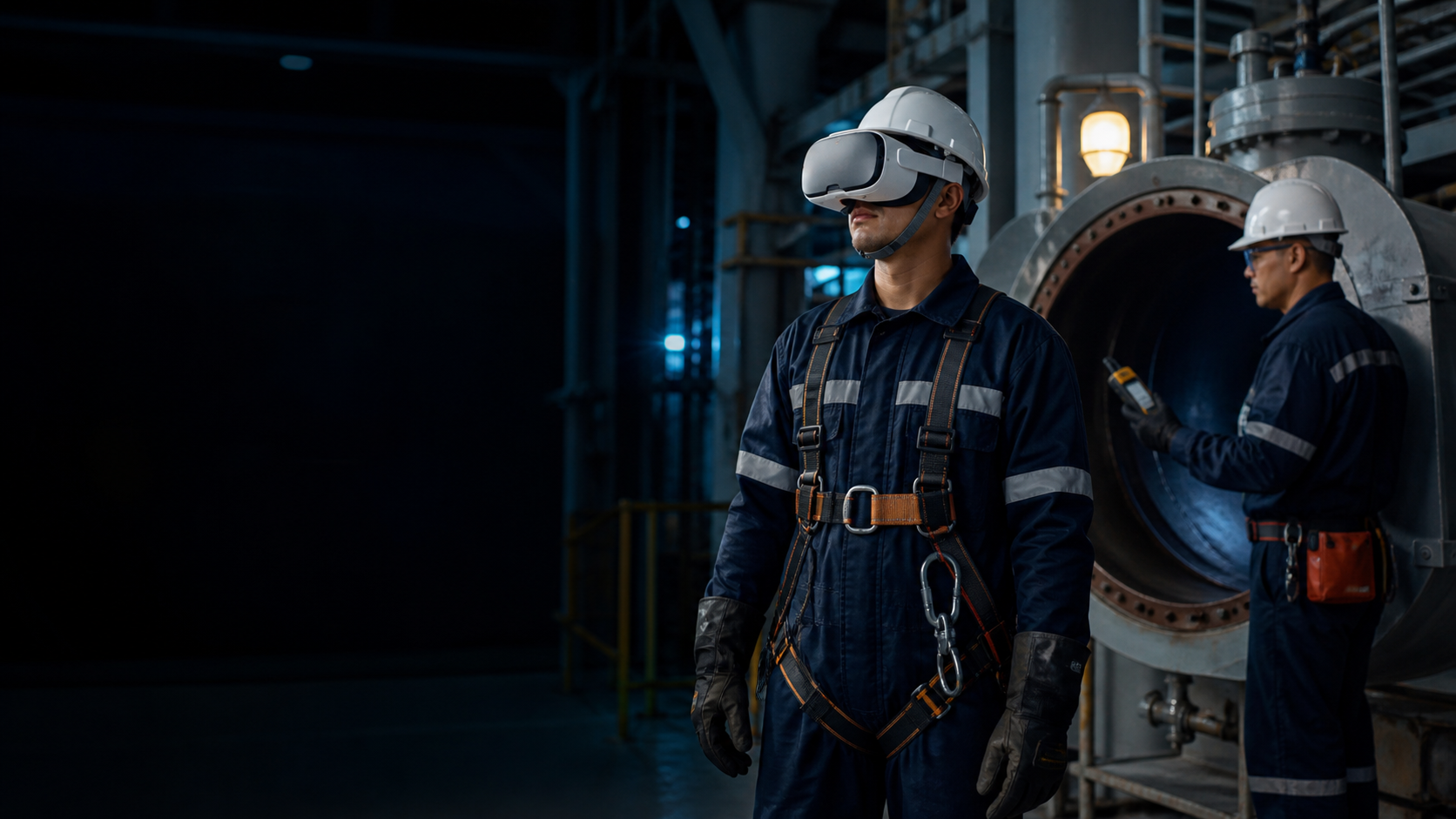
Confined Space VR Training
VR simulations for confined space entry - atmospheric testing, permit procedures, ventilation, and emergency rescue - without ever entering a real confined space.
Confined space incidents are disproportionately fatal - and disturbingly often, the fatality is a would-be rescuer rather than the original victim. Tanks, vessels, trenches, and process vessels can look completely safe from the outside while hiding an oxygen-deficient or toxic atmosphere that gives no visible warning. Traditional training can explain the theory of atmospheric testing and permit procedures, but it can't replicate the pressure of standing at the entry point, gas meter in hand, deciding whether conditions are actually safe to proceed.
Aura Interact's Confined Space module lets trainees practice the full entry sequence - permit verification, atmospheric gas testing, ventilation set-up, and communication with an attendant - inside a realistic virtual tank, vessel, or trench. Because the stakes of getting this wrong are so high, the module places heavy emphasis on early hazard recognition and rescue readiness, letting learners experience low-oxygen and toxic-gas scenarios safely and as many times as it takes to build genuine competence.
Why VR Confined Space Training Is Required
Confined space work punishes hesitation and rewards discipline - and discipline is built through repetition, not a single classroom pass. VR lets trainees run the entire entry sequence from permit check to atmospheric testing to entry, over and over, in a space modeled on their actual tanks or vessels, without shutting down equipment or exposing anyone to a real oxygen-deficient atmosphere. Configurable gas-detector readouts mean learners are reading real instrument data, not a simplified stand-in, so the judgment calls they practice in VR are the same ones they'll make on the job. And because non-entry rescue procedures can be rehearsed just as safely as the entry itself, attendants and entrants both build the coordination that keeps a bad situation from becoming a fatal one.
Core Capabilities
Explore our deep deployment architectures and operational benefits designed to scale with your enterprise.
Core Capabilities
Explore our deep deployment architectures and operational benefits designed to scale with your enterprise.
Targeted Use Cases
Explore real-world scenarios where this product drives operational efficiency, lowers risk, and speeds time-to-insight.
Immersive Onboarding & Briefing
Trainees enter a photorealistic, site-specific VR environment and are walked through the hazard context, learning objectives, and relevant safety protocols before any hands-on activity begins.
Hands-on VR Simulation & Practice
Learners perform the actual task step-by-step using natural hand interactions with realistic tools and equipment, repeating scenarios as many times as needed with zero real-world risk.
Real-Time Feedback & Skill Correction
The simulation detects unsafe actions, missed steps, and procedural errors instantly, coaching the trainee in the moment so bad habits are corrected before they ever reach the job site.
Assessment, Certification & Analytics
Each session is scored against a configurable rubric. Supervisors get individual and team-level analytics dashboards, exportable certificates, and compliance-ready reporting.
Frequently Asked Questions
Find answers to common questions about deploying and scale-monitoring our Confined Space VR Training integrations.
Yes, the module includes configurable gas-detector readouts so trainees learn to interpret real instrument data.
Ready to implement this module?
Contact our enterprise team to learn how the Confined Space VR Training module can be tailored for your specific organizational requirements.
- Seamless enterprise integration with sub-second sync latency
- Compatible with leading spatial computing hardware configurations
- Proprietary secure data models deployed in cloud or on-premise
- Dedicated technical support and pilot onboarding assistance