

Meta VR Glasses: What They Could Mean for BIM and the AEC Industry
 Dhruv Modh
At Meta Connect 2026 (September 23–24), Meta unveiled its new Meta VR Glasses, bringing full VR into a much lighter glasses-style form factor.
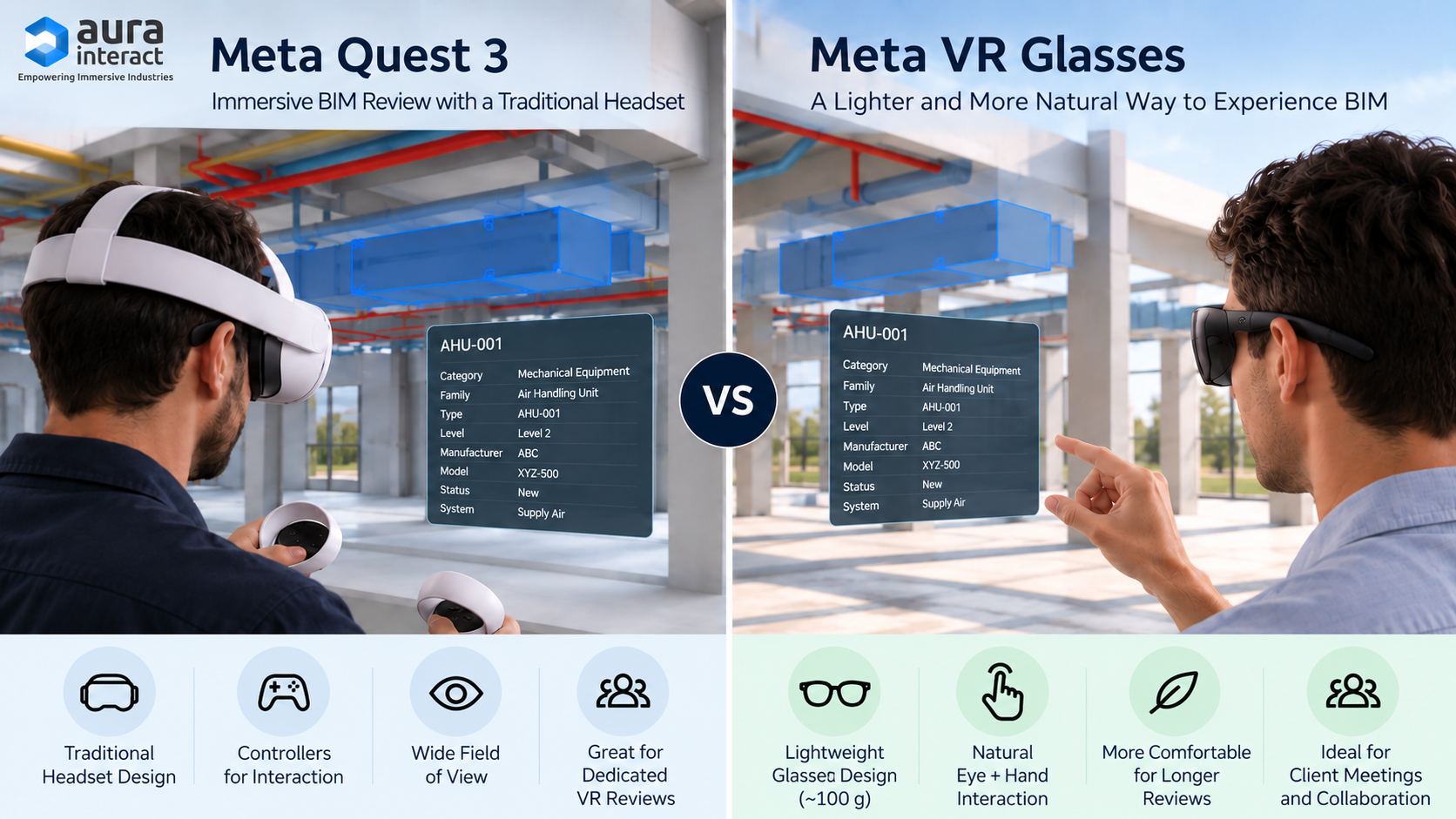
At around 100 grams on the face, the glasses are significantly lighter than a traditional VR headset such as Meta Quest 3. The processing moves into a separate compute puck connected by a thin tether, which is what keeps the part you wear so light. Meta is also moving toward more natural interaction using eye tracking, hand gestures and controller-free navigation.
For the AEC industry, this could be an important step.
VR is already being used for architectural walkthroughs, BIM coordination, client presentations and collaborative design reviews. The challenge is no longer proving that immersive BIM can be useful. The bigger challenge is making VR comfortable and simple enough to become part of everyday project workflows.
Meta VR Glasses could help move that forward.
Key Takeaways
- Meta announced a new lightweight VR device at Meta Connect 2026, expected to ship in Spring 2027.
- At around 100 grams on the face, it could make longer BIM and design-review sessions more comfortable.
- Eye and hand interaction could make VR easier for clients and non-technical stakeholders.
- It runs the same operating system and SDKs as Quest, so existing VR workflows have a clear path onto the new hardware.
- Meta Quest 3 will continue to be useful for immersive BIM reviews and does not suddenly become obsolete.
- For AEC teams, the biggest opportunity is combining lighter VR hardware with a simple BIM-to-VR workflow.
Meta VR Glasses vs Meta Quest 3 for AEC
Meta Quest 3 is already a strong device for immersive BIM visualization. The new glasses are not necessarily a replacement; instead, they offer a different type of experience focused more heavily on comfort and natural interaction.
| Meta Quest 3 | Meta VR Glasses | |
|---|---|---|
| Form factor | Self-contained VR headset | Lightweight glasses tethered to a compute puck |
| Weight on the head | Around 515 g | Around 100 g (plus a ~300 g puck carried separately) |
| Interaction | Controllers + hand tracking | Eyes + hand gestures, controllers optional |
| Field of view | Wider (around 110° × 96°) | Narrower (around 70° × 66°), with higher resolution |
| Best suited for | Dedicated VR reviews and highly immersive sessions | Longer reviews, meetings and client presentations |
| Ease for new users | Requires some familiarity with VR | Designed around more natural interaction |
| Availability | Available today | Expected Spring 2027 (announced at US $1,299.99) |
Meta has confirmed that VR Glasses run on the same Horizon OS as Quest, share the same Store, and use the same SDKs. Meta also expects most existing Quest apps to run at parity or better on the new hardware. That is important because the industry does not need to start again with an entirely new VR platform.
Why Lighter VR Matters for BIM Reviews
A BIM review is different from a five-minute VR demonstration.
Architects, BIM coordinators, engineers and clients may spend much longer walking through different areas of a project, discussing changes, taking measurements and inspecting building components.
With a traditional headset, comfort can become noticeable during longer sessions.
A much lighter device could make those workflows easier to use more regularly.
Imagine an architect taking VR glasses into a client meeting, opening the latest model and letting the client walk through the proposed space without first explaining multiple controller buttons.
Or a project team joining a multiplayer review and spending more time discussing the building rather than thinking about the hardware they are wearing.
That reduction in friction is where the new form factor becomes particularly interesting for professional use.
More Natural Interaction for Clients and Project Teams
Another important change is how users interact with the device.
Meta has designed VR Glasses around eye tracking and hand input as the primary inputs, so users can look toward something and interact using simple gestures rather than depending on physical controllers.
For experienced VR users, controllers are rarely a problem.
But AEC projects involve many people who may not regularly use VR: project owners, consultants, executives, customers and other stakeholders.
For them, a more natural experience can make a real difference.
Inside a BIM environment, this could eventually make common actions feel simpler:
- Look at an element → Select it → View its BIM information
- Select two points → Check a measurement
- Identify an issue → Add an annotation
The higher display resolution could also help here, making BIM labels, property panels and annotations easier to read inside the model.
The less time users spend learning how to operate VR, the more time they can spend reviewing the actual project.
The Bigger Opportunity: BIM + Immersive Collaboration
The hardware is only one side of the story.
For VR to become useful in AEC, teams also need an easy way to take the BIM models they already work with and bring them into an immersive environment.
This is the problem we have been working on at Aura Interact.
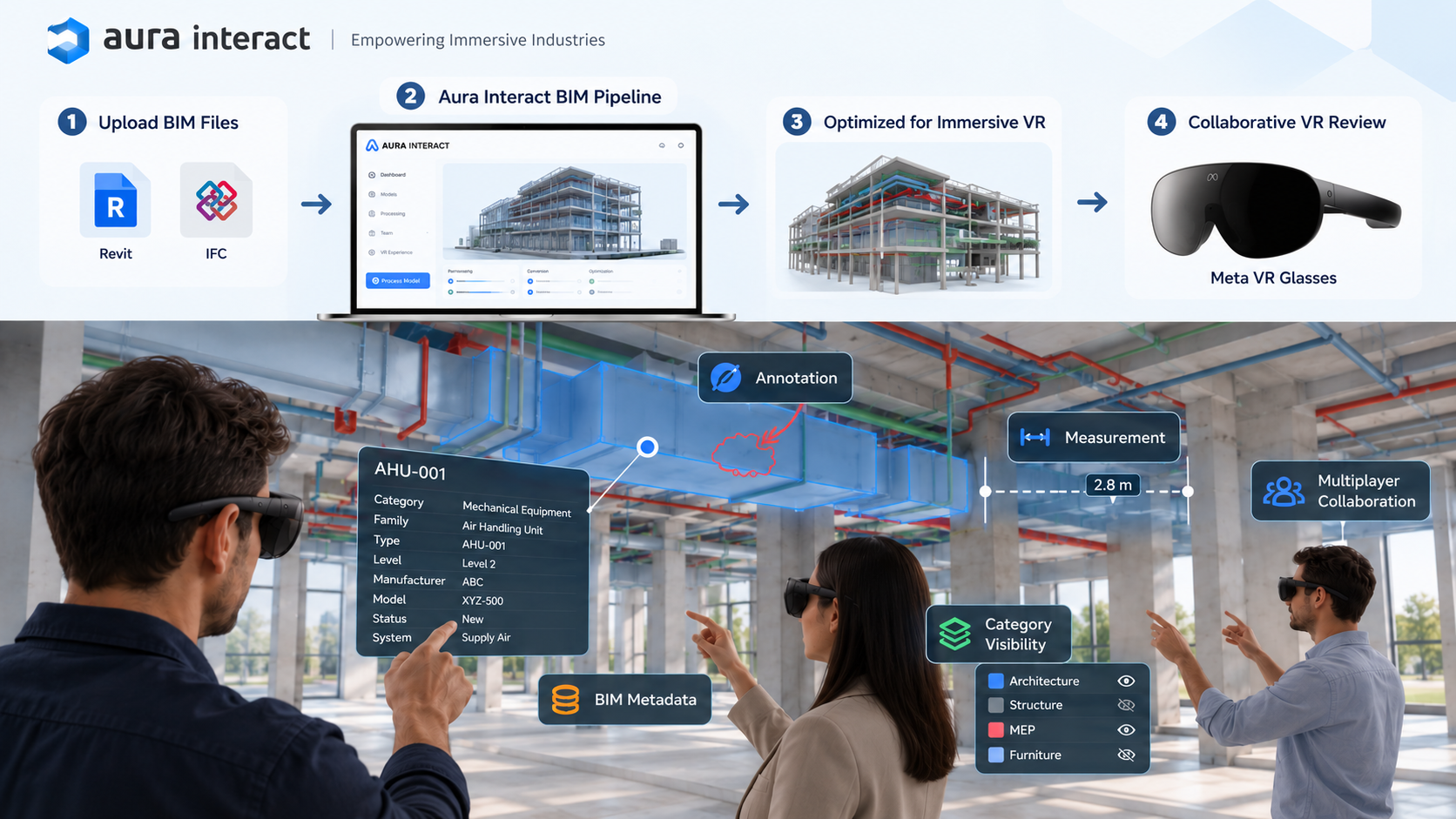
Using the Aura Interact BIM Pipeline Web Dashboard, teams can upload their Revit and IFC files and prepare them for immersive visualization without manually rebuilding the complete model specifically for VR.
The idea is straightforward:
- Revit / IFC → Aura BIM Pipeline → Optimized Model → Collaborative VR Experience
Once inside VR, the BIM model remains more than just 3D geometry.
Teams can experience the project at real-world scale while still working with the information connected to the model.
Teams can:
- Walk through the BIM model at 1:1 scale
- Join multiplayer collaborative reviews
- Add annotations during discussions
- Take measurements directly inside VR
- Select BIM elements and access their semantic metadata
- Toggle BIM categories to focus on architecture, structure, MEP or other systems
BIMAura XR already supports multi-user VR design reviews, model-level BIM information, measurements and issue workflows.
This makes VR useful not only for presentations, but also for practical design coordination and project communication.
Where Meta VR Glasses Could Help Most
Client Presentations
Clients often understand a proposed building much more quickly when they can experience it at real scale.
A lighter, simpler device could make immersive presentations easier to introduce during normal meetings.
BIM Coordination
Architects, structural teams and MEP engineers can review the same model together, isolate relevant elements and discuss issues within their actual spatial context.
Design Reviews
Instead of reviewing every decision through drawings and a desktop screen, teams can experience room sizes, clearances, equipment positions and circulation directly from the user's point of view.
Multiplayer Collaboration
Distributed stakeholders can meet inside the same virtual project instead of only sharing a screen during a call.
This is particularly valuable when several disciplines need to understand the same design problem together.
Does This Mean Quest 3 Is No Longer Useful?
No.
Quest 3 remains a very capable device for professional VR and has some clear advantages of its own: a wider field of view, a self-contained design with no tether, and a lower price. Companies that already use Quest 3 for BIM reviews have no immediate reason to replace their existing hardware.
A more realistic future is that both devices serve different situations.
Quest 3 can continue to work well for dedicated VR stations, internal BIM coordination and highly immersive sessions where a wide view of the space matters.
Meta VR Glasses could become attractive for longer reviews, client meetings and situations where portability and comfort matter more.
That choice could actually help VR adoption because companies will be able to select the device that best fits each workflow rather than forcing every use case onto a single headset.
Frequently Asked Questions
When will Meta VR Glasses be available?
Meta has said the glasses are expected to ship in Spring 2027. They were announced at a US price of $1,299.99.
How much do Meta VR Glasses weigh?
Around 100 grams on the face. The processing sits in a separate compute puck of roughly 300 grams, connected by a thin tether.
Will existing Quest apps work on Meta VR Glasses?
Meta VR Glasses run the same Horizon OS, Store and SDKs as Quest, and Meta expects most existing Quest apps to run at parity or better.
Can Meta VR Glasses be used for BIM reviews?
They are designed for full VR, with eye and hand input, which suits immersive BIM walkthroughs, client presentations and collaborative design reviews. The key is having a workflow that brings Revit and IFC models into VR with their BIM data intact.
Conclusion
VR in AEC is no longer only about creating an impressive walkthrough.
It is increasingly becoming a practical way to review designs, understand BIM information, collaborate with teams and identify issues before they reach the construction site.
Meta's new VR Glasses do not create those use cases. Those workflows already exist.
What they could change is how easy and comfortable those workflows are to use.
With lighter hardware, more natural interaction and the existing Meta VR ecosystem, immersive BIM reviews could become much easier to introduce to architects, engineers, contractors, project owners and clients.
At Aura Interact, our focus is on making the other side of that workflow equally simple.
Through our BIM Pipeline and BIMAura XR, teams can take existing Revit and IFC models into immersive environments, collaborate in multiplayer sessions, inspect BIM data, take measurements and review projects at real-world scale.
The hardware is becoming lighter.
The BIM workflow is becoming faster.
And that combination could bring immersive design review much closer to becoming a normal part of the AEC workflow.

About the Author
Dhruv Modh
Head of R&D & Innovation
Dhruv Modh is an XR Software Engineer. He focuses on complex system design, immersive real-time 3D pipelines, and high-performance interactive application development.
Connect on LinkedIn